

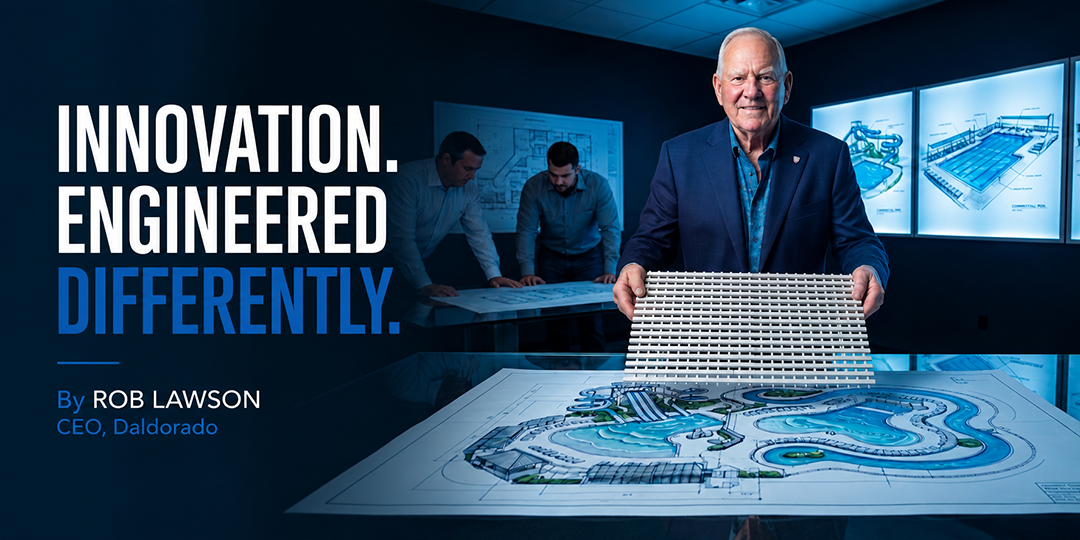
The True Basis of Design
Why the aquatic industry must rethink what it accepted as standard
By Rob Lawson, Founder & CEO, Daldorado
I’ve spent more than 30 years in the commercial aquatic industry, and one thing has become very clear to me:
An industry can adapt to almost anything.
Even compromise.
Over time, systems that were originally intended as temporary solutions can quietly become permanent standards. Workarounds become accepted practices. Maintenance burdens become “part of the business.” And eventually, people stop questioning whether there was ever a smarter way to begin with.
That’s where true innovation starts.
Not by asking:
“What can we add?”
But by asking:
“What never should have been necessary in the first place?”
The Virginia Graeme Baker Pool and Spa Safety Act changed this industry forever.
And it needed to.
The VGBA forced manufacturers, engineers, and aquatic facilities to respond quickly to a very real safety issue. The industry moved fast because it had to move fast. New anti-entrapment standards emerged almost overnight. Existing systems were redesigned. New drain configurations flooded the market.
Lives were protected because of it.
But urgency has a way of creating momentum, and momentum has a way of becoming infrastructure.
Once the industry found compliant solutions, very few stopped afterward to ask:
“Is this the smartest long-term path forward?”
That’s not criticism.
It’s reflection.
Because there’s a difference between solving a problem quickly and solving it intelligently for the next 25 years.
Over the years, I watched the industry gradually normalize more and more complexity.
More SKUs.
More configurations.
More maintenance cycles.
More replacement schedules.
More systems designed around limitations instead of engineered beyond them.
And eventually, all of it started feeling normal.
But “normal” doesn’t always mean optimal.
In many aquatic environments, facilities quietly accepted ongoing maintenance burdens as standard operating procedure. Diver-assisted grate replacement became routine. Components with short warranty cycles became accepted inside infrastructure expected to last decades.
At some point, I started asking myself:
Why are we designing systems around recurring replacement instead of designing systems to reduce replacement altogether?
That question changed everything.
One of the biggest mistakes any industry can make is confusing compliance with leadership.
Compliance establishes the minimum requirement.
Innovation challenges whether the requirement itself can be improved upon through better engineering.
That mindset has guided every product we’ve developed at Daldorado.
I’ve never believed innovation should create more complication. I believe it should remove it.
That philosophy led us to rethink perimeter overflow systems. It led us to challenge how water is captured and managed at the deck edge. It led us to engineer products with longer lifecycle performance rather than shorter replacement expectations.
And today, it’s leading us to rethink main drain systems in ways I believe will fundamentally simplify the future of commercial aquatic design.
Not by adding more.
By eliminating what no longer needs to exist.
One of the things I’ve learned over the years is that water doesn’t care how things have “always been done.”
It follows physics.
And when systems are engineered around inherited assumptions instead of actual performance, inefficiencies become embedded into the environment itself.
For years, many facilities accepted excessive deck water migration, turbulence, and inefficient capture systems as though they were unavoidable.
They weren’t.
Once we started engineering around how water actually behaves—not around legacy habits—better performance became the natural outcome.
Cleaner flow.
Safer decks.
Better efficiency.
Less compromise.
That’s not marketing.
That’s engineering.
Anybody can release products.
Very few companies are willing to challenge the assumptions behind them.
That’s the difference.
At Daldorado, we’ve never been interested in simply participating in the market. We’ve focused on engineering systems that simplify the market itself.
The goal is not to create more things to maintain.
The goal is to reduce what facilities have to fight with in the first place.
That means:
- simplifying system architecture
- reducing unnecessary variation
- improving lifecycle performance
- standardizing functionality
- engineering solutions that integrate more intelligently from the start
Because the best systems are often not the ones with the most components.
They’re the ones that finally remove what never should have been necessary to begin with.
Over the last three decades, the aquatic industry has evolved dramatically. Some of that evolution came through regulation, some through innovation, and some through necessity.
But the next phase of this industry will belong to companies willing to rethink what everyone else stopped questioning years ago.
That is where real progress happens. Not in designing around compromise, but in engineering beyond it.
That has always been our philosophy at Daldorado— and it always will be.
Because this is our lane. There is NO equal.
About the Author
Rob Lawson is the founder and CEO of Daldorado, a leading manufacturer of commercial aquatic drainage and perimeter overflow systems for pools, waterparks, splash pads, and aquatic facilities worldwide. For more than 30 years, Lawson has been at the forefront of aquatic system innovation, helping shape modern approaches to perimeter overflow design, hydraulic efficiency, anti-entrapment safety systems, and integrated aquatic infrastructure.
Known for challenging long-standing industry assumptions, Lawson’s engineering philosophy centers on simplifying system design, improving lifecycle performance, and eliminating unnecessary compromise through smarter, more integrated solutions. His work has contributed to advancements in commercial grating systems, tile and stone support technologies, sump engineering, and standardized aquatic system architecture.
Daldorado products are specified in commercial aquatic facilities throughout the United States and internationally, serving municipalities, resorts, waterparks, competition pools, and high-performance aquatic environments.




Pool images shown may or may not be an actual representation of a product provided by Daldorado.
For product samples or project examples please contact a Daldorado Sales Representative at 1.888.509.8128
© 2017-2020 Daldorado, LLC. All Rights reserved. Design & Development by ColorAmerica.com : Privacy